

Animal Health Pharmaceuticals Are Reshaping Modern Farming
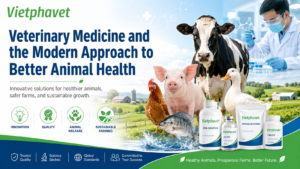
Modern livestock production is changing fast. Farmers today are no longer focused only on producing more meat, eggs, milk, fish, or shrimp. They are also under pressure to improve animal welfare, control disease risks, reduce production losses, maintain food safety, and manage farms more efficiently.This is where animal health pharmaceuticals have become increasingly important. From veterinary medicines and nutritional products to disinfectants, supportive solutions, and farm-health programs, modern animal healthcare helps farmers create stronger herds and flocks while improving the long-term performance of their operations. The image of healthy cattle, pigs, poultry, aquaculture species, modern farms, laboratories, and veterinary products represents a major shift in agriculture. Animal health is no longer simply about treating disease after it appears. It is becoming a complete management strategy that combines prevention, monitoring, nutrition, biosecurity, professional veterinary support, and scientifically developed products.
Why Animal Health Pharmaceuticals Matter More Than Ever in Modern Farming
Disease is one of the biggest threats to livestock and aquaculture productivity. When animals become sick, farmers can face reduced feed intake, slower growth, lower reproductive performance, poorer feed conversion, increased mortality, and higher production costs. Disease outbreaks may also spread quickly across farms when biosecurity and disease-control measures are inadequate. For this reason, animal health pharmaceuticals play an important role within a broader animal-health management program. They can support disease prevention and treatment, help animals recover from stressful periods, and contribute to more stable farm performance when used appropriately.

Modern farming systems often involve larger populations of animals, more intensive production, and faster movement of animals, feed, equipment, and people between locations. These factors can increase disease pressure if farms do not maintain strong management systems. Veterinary medicines therefore work best when combined with appropriate vaccination programs, farm hygiene, environmental control, good nutrition, clean drinking water, disease monitoring, and veterinary supervision. A bottle of veterinary medicine alone cannot solve every production problem. The most successful farms increasingly focus on integrated animal-health management.
The role of animal health pharmaceuticals is also expanding because farmers are becoming more aware of preventive healthcare. Instead of waiting until animals show severe clinical signs, producers are paying more attention to early indicators such as reduced feed consumption, abnormal feces, coughing, respiratory difficulty, reduced activity, uneven growth, or unexpected changes in production. Early detection allows farms to investigate the underlying cause and respond more quickly. This may reduce the economic impact of disease and prevent a small health issue from becoming a major farm-level problem.
At the same time, responsible pharmaceutical use is becoming more important. Veterinary medicines should be selected based on the actual health condition, species, diagnosis, product indication, and professional guidance where required. Antibiotics in particular should not be used simply as a routine substitute for good farm management. Responsible use protects animal health, supports treatment effectiveness, and contributes to efforts to reduce antimicrobial resistance.
From Disease Control to Better Productivity and Stronger Animals
The value of animal health pharmaceuticals extends beyond treating obvious disease. Healthy animals are generally better positioned to consume feed normally, convert nutrients efficiently, maintain growth, reproduce successfully, and cope with environmental challenges. This is especially important in commercial farming, where even small changes in mortality, average daily gain, feed conversion, egg production, milk yield, or survival rate can significantly affect profitability.
For pigs, poultry, cattle, goats, sheep, and other livestock, respiratory and digestive problems remain common production concerns. Environmental stress, sudden temperature changes, poor ventilation, contaminated feed or water, pathogens, overcrowding, and weak biosecurity can all affect animal performance. A comprehensive health program may therefore combine veterinary medicines with vitamins, minerals, electrolytes, probiotics, nutritional supplements, and farm sanitation products depending on the needs of the animals.

Aquaculture creates another important market for animal health pharmaceuticals. Fish and shrimp are highly dependent on water quality, stocking conditions, nutrition, dissolved oxygen, temperature, salinity, pH, and overall pond management. A sudden environmental change can rapidly affect the entire production system. Because of this, aquaculture health management increasingly combines water treatment, environmental monitoring, biosecurity, nutritional support, pathogen control, and appropriate veterinary or aquatic-health products.
The connection between animal health and farm productivity is straightforward. A healthier population usually experiences fewer interruptions in the production cycle. Farmers can reduce avoidable losses, improve uniformity, maintain more predictable harvesting schedules, and use farm resources more effectively. However, pharmaceutical products should always be viewed as one component of a complete production system. Proper housing, ventilation, stocking density, nutrition, water quality, vaccination, farm hygiene, and trained personnel remain essential.
This is one reason professional manufacturers of animal health pharmaceuticals are moving beyond simply supplying products. Many companies now provide technical information, disease-management guidance, product education, farm-support materials, and distributor training. This allows distributors, veterinarians, technical teams, and farmers to better understand how each product should fit into an overall health-management program.
Science Quality and Innovation Are Transforming Veterinary Medicine
The modern veterinary pharmaceutical industry is increasingly connected to research, manufacturing technology, quality control, and international production standards. Farmers and distributors want products that are consistent, stable, practical to use, and supported by clear technical information. As livestock production becomes more professional, demand for reliable animal health pharmaceuticals is likely to continue growing.
Quality begins long before a finished product reaches a farm. Raw-material selection, formulation, manufacturing processes, environmental controls, laboratory testing, packaging, storage, and distribution can all affect product consistency. Pharmaceutical companies therefore need strong quality-management systems to ensure that products meet defined specifications before entering the market.
Innovation is equally important. Livestock producers face changing disease patterns, climate-related stress, rising production costs, stricter food-safety requirements, and increasing expectations around sustainable farming. Modern animal health pharmaceuticals must therefore respond to practical farm challenges rather than simply adding more products to the market.

One major trend is greater focus on convenience. Farmers and veterinarians increasingly prefer products that are practical to administer, clearly labeled, easy to store, and compatible with modern farming systems. Packaging is also becoming more important because good packaging protects product quality while making the product easier for distributors and farmers to recognize.
Another major development is the integration of digital communication into veterinary medicine. QR codes, digital catalogs, technical videos, online product information, farm-management platforms, and social media education are helping manufacturers communicate directly with distributors and farmers. A veterinary pharmaceutical brand is no longer judged only by what is inside the bottle. Customers increasingly evaluate technical support, accessibility, product information, responsiveness, and overall brand credibility.
This means manufacturers of animal health pharmaceuticals need to communicate science in a way that farmers can actually use. Technical information should remain accurate but also practical. Farmers need to understand what a product is designed for, how it should be used, what management practices should accompany it, and when professional veterinary advice is necessary.
Animal Health Pharmaceuticals and the Future of Sustainable Farming
Sustainability in livestock production is closely connected to animal health. Sick animals require more time, feed, labor, medication, and other resources to reach production targets. High mortality also represents wasted resources and lost economic value. By supporting effective disease prevention, early intervention, and responsible treatment, animal health pharmaceuticals can contribute to more efficient farming systems.
The future of animal healthcare will likely involve stronger integration between pharmaceuticals, diagnostics, nutrition, genetics, farm technology, data analysis, and biosecurity. Instead of treating each health problem separately, producers will increasingly use data to identify patterns and make earlier management decisions. Sensors, automated feeding systems, environmental monitoring equipment, digital farm records, and laboratory diagnostics can help detect potential problems before major losses occur.
Veterinary pharmaceutical companies also have an opportunity to work more closely with distributors. Local distributors often serve as an important bridge between manufacturers and livestock farmers. They understand regional farming conditions, seasonal disease challenges, purchasing behavior, and the practical concerns of customers. Strong cooperation between manufacturers, distributors, veterinarians, and technical teams can therefore make animal health pharmaceuticals more accessible while improving product education at the point of sale.
Retail visibility also matters. Well-organized product displays, clear brochures, educational posters, professional packaging, and trained sales teams help customers understand product categories more easily. For veterinary pharmaceutical brands, strong point-of-sale communication can build recognition and improve trust, especially in markets where farmers often depend on local dealers for technical recommendations and product availability.
As livestock and aquaculture production continues to modernize, farmers will expect more than individual products. They will look for complete animal-health solutions supported by consistent quality, technical knowledge, reliable distribution, and responsible use. Manufacturers that can combine scientific development with practical farm support will have a stronger position in the market.
For companies operating in this sector, animal health pharmaceuticals should therefore be positioned around a broader value proposition — healthier animals, more efficient farms, safer food production, and stronger agricultural communities. The brands that successfully connect pharmaceutical quality with real farming outcomes will be better prepared for the next generation of animal production.